Publications
2026
-
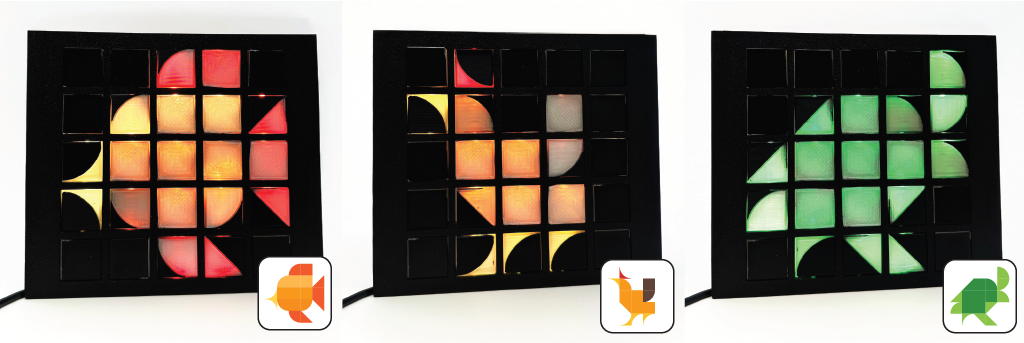 Diceplay: A Modular Canvas for Physical Image CompositionMilin Kodnongbua, Zihan Zhang, Shishi Xiao, Vivian Li, Heather Robertson, and 3 more authorsIn SIGGRAPH 2026 Conference Papers 2026
We present Diceplay, a modular physical display for abstract visual composition built from a grid of identical dice. Each die has six faces with distinct geometric primitives, and images emerge through the placement and orientation of the dice. While this medium enables reusable and reconfigurable physical imagery, it poses a challenging design problem: images must be expressed through discrete, extremely low-resolution abstractions, making manual authoring difficult. To address this challenge, we introduce a computational design system that automatically generates Diceplay configurations from text prompts. Our key technical contribution is a grammar-based formulation that relaxes this discrete design space into a smooth optimization landscape, enabling gradient-based optimization using score distillation sampling. We show that our approach consistently produces meaningful abstractions for this medium, whereas state-of-the-art smoothing techniques fail in this extremely challenging regime. We demonstrate our method across a range of prompts and fabricated examples, showing how computationally generated abstractions can be realized as physical visual artifacts.
2025
-
 Design for Descent: What Makes a Shape Grammar Easy to Optimize?Milin Kodnongbua, Zihan Zhang, Nicholas Sharp, and Adriana SchulzIn SIGGRAPH Asia 2025 Conference Papers 2025
Shape grammars offer a powerful framework for computational design, but synthesizing shape programs to achieve specific goals remains challenging. Inspired by the success of gradient-based optimization in high-dimensional, nonconvex spaces such as those in machine learning, we ask: what makes a shape grammar amenable to gradient-based optimization? To explore this, we introduce Stochastic Rewrite Descent (SRD), an algorithm that interleaves structural rewrites with continuous parameter updates, taking steps in both to optimize a given objective. We analyze the core challenges which have previously prevented optimizing shape programs via descent, and identify a set of desirable properties for grammars that support effective optimization, along with concrete grammar design recommendations to achieve them. We validate this approach across three shape grammars, demonstrating its effectiveness in diverse domains including image fitting, text-driven generation, and topology optimization. Through ablations and comparisons, we show that grammars satisfying our proposed properties lead to significantly better optimization performance. The goal of this work is to open the door to more general and flexible computational paradigms for inverse design with shape grammars.
2024
-
 Dense Server Design for Immersion CoolingMilin Kodnongbua, Zachary Englhardt, Ricardo Bianchini, Rodrigo Fonseca, Alvin Lebeck, and 4 more authorsACM Trans. Graph. Nov 2024
The growing demands for computational power in cloud computing have led to a significant increase in the deployment of high-performance servers. The growing power consumption of servers and the heat they produce is on track to outpace the capacity of conventional air cooling systems, necessitating more efficient cooling solutions such as liquid immersion cooling. The superior heat exchange capabilities of immersion cooling both eliminates the need for bulky heat sinks, fans, and air flow channels while also unlocking the potential go beyond conventional 2D blade servers to three-dimensional designs. In this work, we present a computational framework to explore designs of servers in three-dimensional space, specifically targeting the maximization of server density within immersion cooling tanks. Our tool is designed to handle a variety of physical and electrical server design constraints. We demonstrate our optimized designs can reduce server volume by 25–52% compared to traditional flat server designs. This increased density reduces land usage as well as the amount of liquid used for immersion, with significant reduction in the carbon emissions embodied in datacenter buildings. We further create physical prototypes to simulate dense server designs and perform real-world experiments in an immersion cooling tank demonstrating they operate at safe temperatures. This approach marks a critical step forward in sustainable and efficient datacenter management.
2023
-
 ReparamCAD: Zero-shot CAD Re-Parameterization for Interactive ManipulationMilin Kodnongbua, Benjamin Jones, Maaz Bin Safeer Ahmad, Vladimir Kim, and Adriana SchulzIn SIGGRAPH Asia 2023 Conference Papers Nov 2023
Parametric CAD models encode entire families of shapes that should, in principle, be easy for designers to explore. However, in practice, parametric CAD models can be difficult to manipulate due to implicit semantic constraints among parameter values. Finding and enforcing these semantic constraints solely from geometry or programmatic shape representations is not possible because these constraints ultimately reflect design intent. They are informed by the designer’s experience and semantics in the real world. To address this challenge, we introduce ReparamCAD, a zero-shot pipeline that leverages pre-trained large language and image model to infer meaningful space of variations for a shape We then re-parameterize a new constrained parametric CAD program that captures these variations, enabling effortless exploration of the design space along meaningful design axes. We evaluated our approach through five examples and a user study. The result showed that the inferred spaces are meaningful and comparable to those defined by experts. Code and data are at: https://github.com/milmillin/ReparamCAD.
-
 B-Rep Matching for Collaborating Across CAD SystemsBenjamin Jones, James Noeckel, Milin Kodnongbua, Ilya Baran, and Adriana SchulzACM Trans. Graph. (SIGGRAPH) Jul 2023
-
 Self-Supervised Representation Learning for CADBenjamin T. Jones, Michael Hu, Milin Kodnongbua, Vladimir G. Kim, and Adriana SchulzIEEE / CVF Computer Vision and Pattern Recognition Conference (CVPR) Jul 2023
